
with incredible contrasts: from stark desert to snow-capped Mount Hermon; from secular
Tel Aviv to observant B’nai Brak; from shepherding to software developing; and
from tragedy to joy.
 We just had a mini-vacation in Crete where I also found
interesting polarities. Israel is just a two-hour flight to Athens, and from
there, it is a quick hop to many Greek islands. There is no time change and the
best kept secret is that Greece in the winter is quiet; no cruise ships equals very
few tourists.

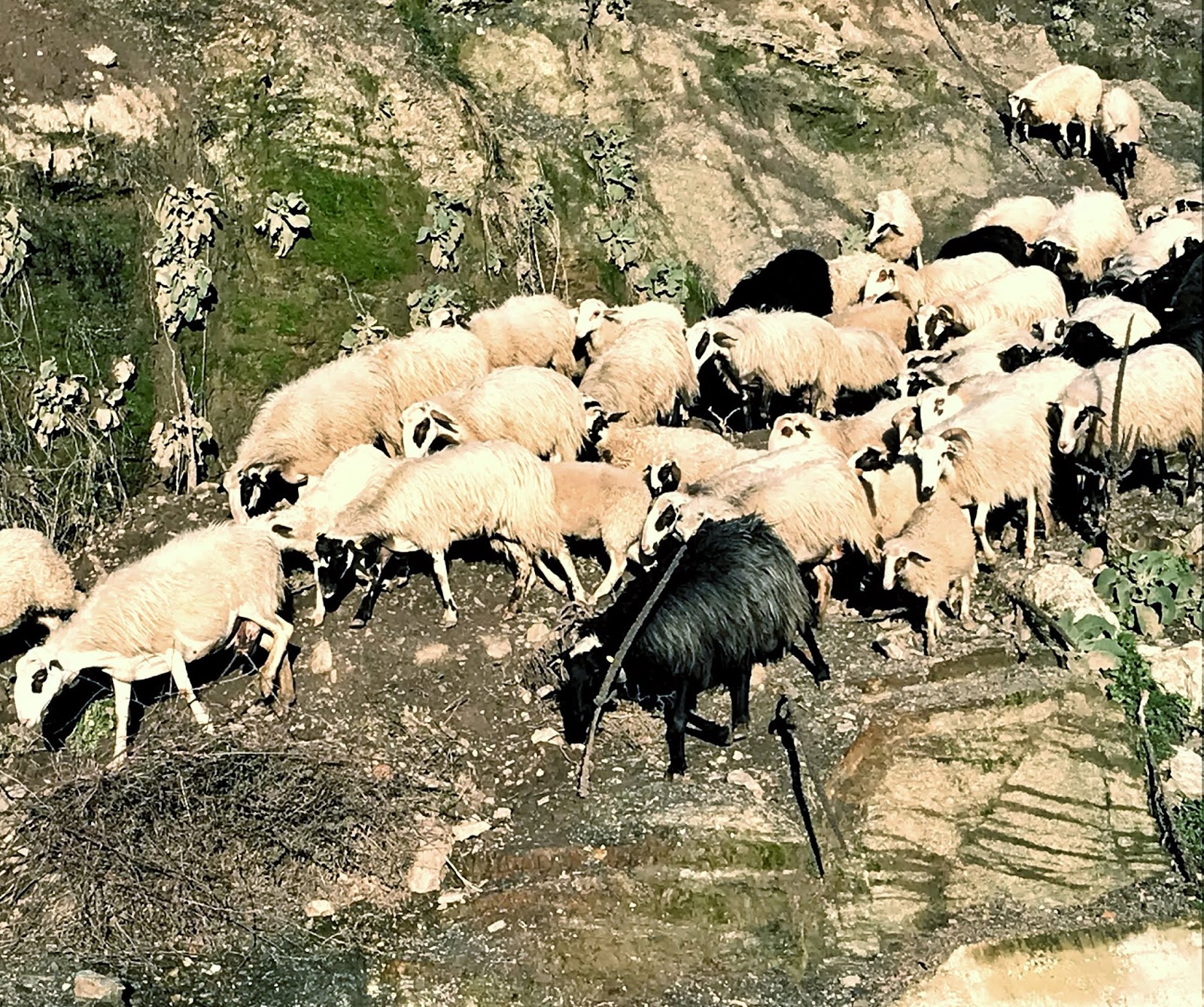 No one was
in a rush except for sheep and mountain goats who had taken over the empty hiking
paths, jangling bells echoing across steep marbled gorges. The sea was a vibrant
blue. Stark-white villages clung to cliffs and soaring mountains
were clad in snow.
 To capture the azure sea and sparkling snow-capped mountains
in one vista is inconceivable, unimaginable, yet mezmerizing. A paradox.
 In
Injust one afternoon, we hiked down a gorge in Akotiri, dipping our feet in the
Mediterranean, then threw snowballs in the blustery White Mountains. The Cretans
certainly appreciated this glorious backdrop, often constructing open-air theaters with direct
mountain vistas.
 |
| Mosaic from walls of Knossos Palace |
many wars, rulers and invasions across a span of 4,000 years of civilization. After
the decline of the peaceful, progressive and creative Minoans, the island was
ruled by Dorians, Romans, Saracens, Byzantines, Venetians, Turks and, during
the Second World War, the Germans.

active trading ports, yet a place of defeat and loss. Most villages
we visited had a memorial to the Cretans who were killed in the Second World
War.
evidence of a Jewish community in Crete since 142 BCE. Josephus was married to a
Cretan Jew who was living in Jerusalem. By 1481 there were 600 Jewish families and four synagogues in Chania and soon after, exiles from the Spanish Inquisition were
welcomed to the community.
Under Venetian rule, they had to wear a Jewish badge. They were accused of blood
libels by the church, were highly taxed, imprisoned and suffered many massacres.
Yet they somehow survived for close to 2,000 years.
in May 1941, they surrounded the Jewish quarter of Chania and rounded up the
remaining 263 Cretan Jews. Men, women and children were imprisoned and, together
with Greek and Italian prisoners, placed on a ship destined for Auschwitz.
A day later, the ship was torpedoed by the British. Everyone on board was killed
and 2,000 years of Jewish life in Crete was erased.
 Another paradox in the story is that even though the Jews
were wiped out, one synagogue stands today. The Etz Hayyim Synagogue in Chania, once in
ruins, is now fully restored and operational. A testament to a once thriving
Jewish life in Crete, Shabbat prayers are heard on Fridays and guest rabbis
perform service on the Jewish holidays.

sanctuary. An original etrog tree stood in the courtyard, heavy with yellow fruit.
 |
| The restored mikveh |
an underwater stream. Cats also stood guard atop three graves of rabbis just outside the sanctuary.
 |
| Venetian-style door in Jewish Quarter |
and chic cafes. Looking out to sea, I thought of those last Jews imprisoned on a
flaming ship that sank into the depths.
Crete are now open and welcoming, conveying a feeling of love and care. This too
is the story of Israel. It is the Jewish paradox and we are living it.

<!–
/* Font Definitions */
@font-face
{font-family:"Cambria Math";
panose-1:2 4 5 3 5 4 6 3 2 4;
mso-font-charset:0;
mso-generic-font-family:roman;
mso-font-pitch:variable;
mso-font-signature:-536870145 1107305727 0 0 415 0;}
@font-face
{font-family:Calibri;
panose-1:2 15 5 2 2 2 4 3 2 4;
mso-font-charset:0;
mso-generic-font-family:swiss;
mso-font-pitch:variable;
mso-font-signature:-536859905 -1073732485 9 0 511 0;}
/* Style Definitions */
p.MsoNormal, li.MsoNormal, div.MsoNormal
{mso-style-unhide:no;
mso-style-qformat:yes;
mso-style-parent:"";
margin:0cm;
margin-bottom:.0001pt;
mso-pagination:widow-orphan;
font-size:12.0pt;
font-family:"Calibri",sans-serif;
mso-ascii-font-family:Calibri;
mso-ascii-theme-font:minor-latin;
mso-fareast-font-family:Calibri;
mso-fareast-theme-font:minor-latin;
mso-hansi-font-family:Calibri;
mso-hansi-theme-font:minor-latin;
mso-bidi-font-family:Arial;
mso-bidi-theme-font:minor-bidi;
mso-bidi-language:AR-SA;}
.MsoChpDefault
{mso-style-type:export-only;
mso-default-props:yes;
font-family:"Calibri",sans-serif;
mso-ascii-font-family:Calibri;
mso-ascii-theme-font:minor-latin;
mso-fareast-font-family:Calibri;
mso-fareast-theme-font:minor-latin;
mso-hansi-font-family:Calibri;
mso-hansi-theme-font:minor-latin;
mso-bidi-font-family:Arial;
mso-bidi-theme-font:minor-bidi;
mso-bidi-language:AR-SA;}
@page WordSection1
{size:595.0pt 842.0pt;
margin:72.0pt 72.0pt 72.0pt 72.0pt;
mso-header-margin:35.4pt;
mso-footer-margin:35.4pt;
mso-paper-source:0;}
div.WordSection1
{page:WordSection1;}
–>
Discover more from Life in Israel
Subscribe to get the latest posts sent to your email.

 Life in Israel